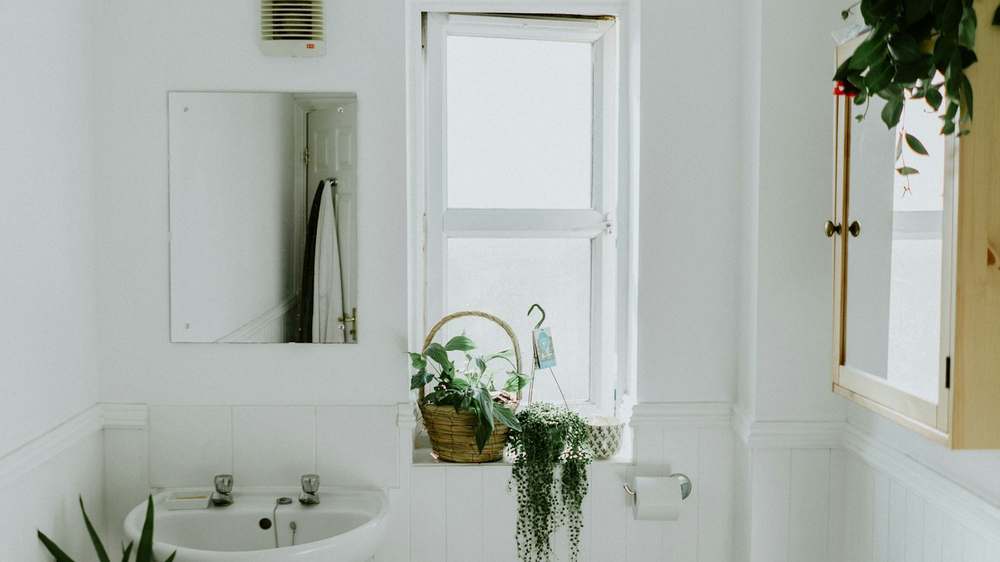
A bathroom without a cabinet is not a bathroom without storage. It is a bathroom where every surface has been claimed by bottles standing upright, which is the least efficient arrangement possible.
Bottles are tall, narrow, unstable, and need to be seen from the side to identify them. A shelf of standing bottles wastes roughly 60% of the volume it occupies. Lying them down, hanging them, or moving them into a drawer recovers most of that.
This is the plan for a typical 2.4 m × 1.8 m bathroom with no cabinet, no permission to drill, and a budget under $150.
Start with an honest inventory
Before buying anything, take every bottle out of the bathroom and lay it on the floor. Group by frequency of use.
In most households the breakdown looks like this:
| Category | Typical count | Used |
|---|---|---|
| Toothbrush, toothpaste, soap, face wash, one moisturiser | 5–6 | Twice daily |
| Shampoo, conditioner, body wash, razor, deodorant | 5–8 | Several times a week |
| Hair products, styling tools, spare towels | 5–10 | Weekly |
| Hair masks, nail kit, first aid, spare toothpaste | 10–20 | Monthly or less |
| Cleaning products | 5–10 | Weekly |
| Products not in current rotation | 5–15 | Rarely |
The last two rows are usually the surprise. Most bathrooms contain 40–60 items of which only 12 are genuinely daily. The clutter is almost always category four: things kept in the bathroom for no better reason than that is where they ended up.
Anything used less than monthly does not need to live in the bathroom. Moving it out is the single largest capacity gain available, and it costs nothing.
Allocate the four walls
A small bathroom has four usable wall zones. Allocate them by access, not by product category.
Zone 1: beside the sink, at hand height
This is for the five or six daily items. Nothing else. Ever.
Best method: a small wall shelf or an adhesive caddy, under 2 kg load. This is the one place where adhesive is genuinely reliable, because the load is light, the wall is usually smooth, and the items are needed frequently enough that you notice immediately if it starts to fail.
Avoid: hanging a mirror here with adhesive if it weighs over 2 kg. Mirrors are the most common adhesive failure in bathrooms because they have a lever effect — the bottom edge pulls away from the wall under its own weight, and once the top edge starts to peel, it goes quickly.
If you want a large mirror in a rental, lean it against the wall and sit it on the counter, or use a mirror that comes with a stand. It is not the elegant solution, but it does not fall.
Zone 2: inside the shower, at chest height
Shampoo and body wash, nothing else. Two items, maybe three.
Best method: a tension rod across the shower enclosure with hanging baskets. Holds 5–10 kg, leaves no marks, and is repositionable — which matters because you will get the height wrong the first time.
Alternative: a corner pole caddy that stands on the shower floor and grips the ceiling. Holds more (10–15 kg) but occupies floor space, which in a small shower is a real cost. In a 80 × 80 cm shower, a corner caddy eats a noticeable amount of standing room.
Avoid: adhesive shelves inside the shower. Steam and constant wet-dry cycling are exactly the conditions that defeat adhesive. They will fall, usually at 3am, usually onto your foot.
Zone 3: above the toilet
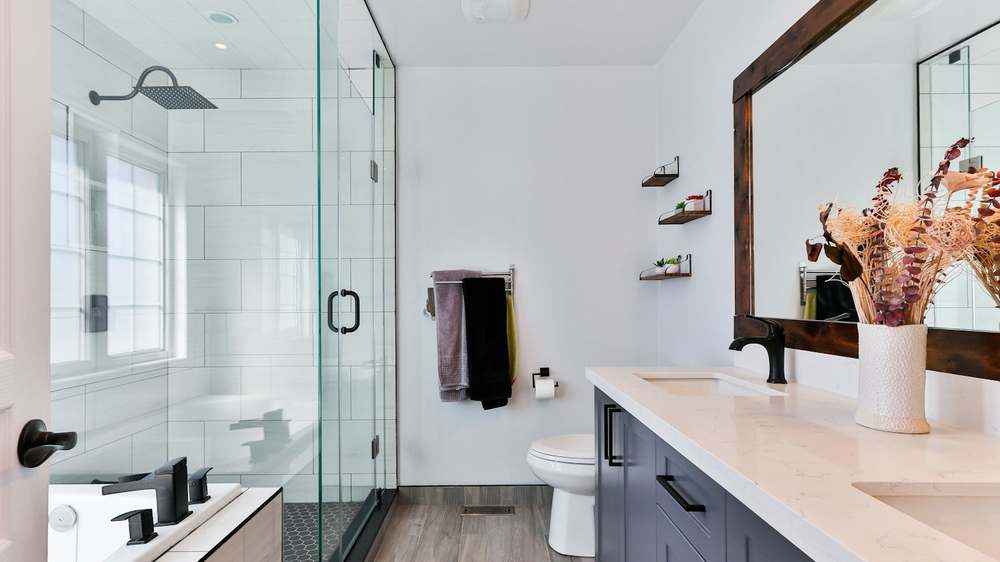
The single most wasted space in small bathrooms, typically 30 cm deep × 50 cm wide × 60 cm tall above the cistern.
Best method: an over-toilet shelf unit. These are freestanding, stand on the floor around the toilet base, and typically provide three shelves of roughly 25 × 60 cm.
Load: 20–40 kg depending on the model, held by the frame rather than by the wall. Zero wall contact, zero damage.
This one piece of furniture typically doubles a small bathroom's storage capacity. It is the highest-value purchase in this entire guide.
What to check before buying:
| Check | Why it matters |
|---|---|
| Distance from wall to front of cistern | The unit's rear legs must clear the cistern |
| Height of the cistern lid | Determines which shelf sits above it |
| Floor area at the toilet base | Some units need 60 cm width |
| Pipe positions at the floor | Rear legs may foul a soil pipe boxing |
Measure these four things and write them down. Over-toilet units are the most commonly returned bathroom product because people buy on sight without measuring the cistern clearance.
Zone 4: the back of the door
Hanging space for towels, robes, and a laundry bag.
Best method: an over-door hook rack. 10–15 kg distributed across hooks.
Note that bathroom doors are often hollow-core with a thin top edge. Check the door thickness before buying — most racks fit 35–45 mm doors. A rack that does not fit will sit crooked and eventually split the door edge.
Where the bottles actually go
The insight that makes this work: most bathroom bottles are standing upright on a surface because there is no better place, not because standing is correct.
Three better arrangements:
Lying down in a drawer. A shallow drawer with dividers holds 15–20 bottles horizontally in the space that would hold six upright. The constraint is that you cannot read labels from above, so label the caps with a marker, or arrange by position and keep the arrangement stable.
Hanging from a rail. Pump bottles can hang from a rail using a simple hook through the pump collar. This moves them off the surface entirely. Best for products used in the shower.
In a wall-mounted basket, tilted. Bottles in a basket at a slight angle are visible and drainable, and take up wall space rather than floor space. This is the most space-efficient option for frequently-used products.
What not to buy
Matching sets of containers. Bathroom products come in shapes designed for shelf display in a shop, not for your bathroom. Decanting into matching containers is aesthetically satisfying and functionally neutral — it does not create space, and it destroys the label information you need to avoid mixing up two similar bottles.
Suction-cup anything. Suction cups on tile fail within weeks. On grout lines they fail immediately. There is no exception to this.
Corner shelves with adhesive. The corner geometry means the load is concentrated at one edge. They peel, usually within a month.
Over-cabinet racks if you do have a cabinet. They block access to the cabinet and hold very little.
Freestanding floor cabinets narrower than 30 cm. These look like they will fit in a gap and then tip over when loaded. If it is narrower than 30 cm and taller than 60 cm, it needs to be fixed to the wall, which defeats the purpose.
Realistic capacity
A bathroom with no cabinet, using the four zones above:
| Zone | Capacity |
|---|---|
| Beside sink | 6 daily items |
| In shower | 3 bottles |
| Above toilet | 20–30 items across three shelves |
| Back of door | Towels + laundry bag |
That is roughly 40 items, which covers a typical household's actual daily and weekly needs.
The remaining occasional items — spare products, first aid, cleaning supplies — should live outside the bathroom. A hall cupboard, under the kitchen sink, or a labelled storage box elsewhere.
Trying to fit the occasional category into a small bathroom is what produces clutter in the first place. Move it out instead. It is the fastest win available and it costs nothing.
Time and cost
| Item | Cost | Time to install |
|---|---|---|
| Tension rod + 2 baskets | $15–25 | 5 min |
| Over-toilet shelf unit | $40–80 | 30 min assembly |
| Over-door rack | $15–25 | 2 min |
| Small sink shelf (adhesive) | $10–20 | 10 min |
| Total | $80–150 | under an hour |
No drilling, nothing that damages the wall, and everything removable in minutes if you move out.
Keeping it working after week one
The failure pattern in small bathrooms is predictable: it looks great in week one, then bottles accumulate on the counter again because the daily items drifted out of their zone.
Two habits prevent this:
The five-item rule. The counter beside the sink holds five items maximum. When a sixth appears, one must leave. Five is roughly what an adult genuinely uses twice a day, and it is small enough that it stays clear.
The weekly reset. Once a week, take everything off the counter and put back only what belongs. It takes two minutes and stops the slow accumulation that undoes the whole setup.
Neither habit requires buying anything, and together they are what turns a one-afternoon setup into a system that survives.
If your bathroom has no wall space at all
Some bathrooms, particularly in converted flats and older buildings, have less than 1.5 m² of usable wall because of windows, radiators, and doors.
In that situation:
- The over-toilet unit becomes mandatory rather than optional, because it is the only method that uses floor space and wall height simultaneously without wall contact
- Everything used less than weekly moves out of the room permanently
- A tall narrow cabinet in the hallway outside the bathroom, holding towels and spares, often works better than fighting for centimetres inside
That last option feels like a compromise and usually is not. In a genuinely small bathroom, the most useful thing you can do is decide what does not belong there.