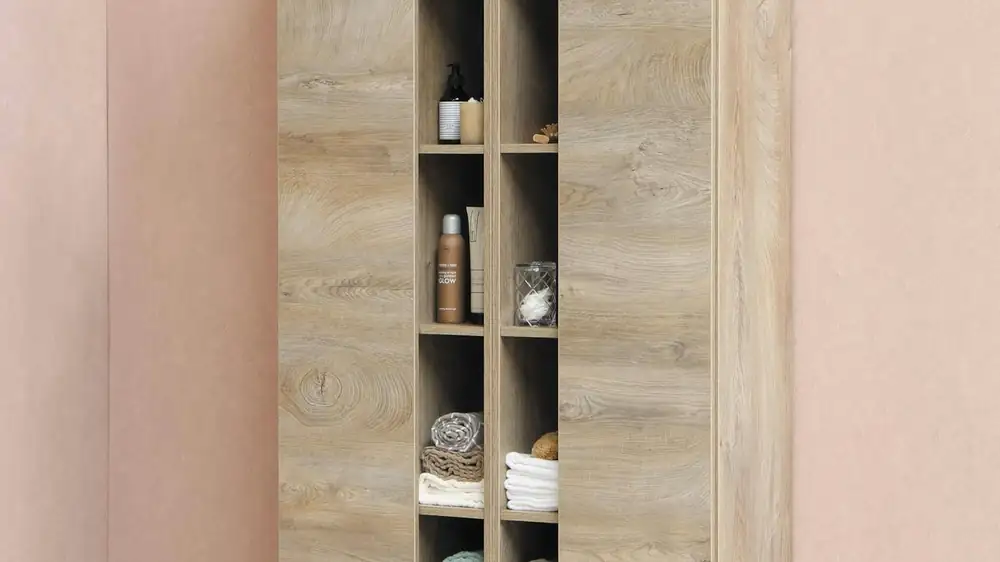
A wardrobe is the most expensive item of furniture in a small bedroom, and in a rental the wall-fixed version usually needs permission you will not get.
The alternative is not "a rail in the corner". There are four freestanding systems that hold a genuine wardrobe's contents, and they differ significantly in capacity and stability.
The capacity a wardrobe needs to hold
Before choosing a system, know the target. A typical adult's wardrobe:
| Category | Items | Space needed |
|---|---|---|
| Hanging (shirts, dresses, coats) | 20–30 | 100 cm of rail |
| Folded (t-shirts, jumpers, jeans) | 40–60 | 4 shelves or 2 drawers |
| Underwear, socks | 20–30 | 1 drawer |
| Shoes | 8–12 pairs | 1 shelf or rack |
| Bags, accessories | 5–10 | 1 shelf |
Total: about 1.2 m of rail plus 4–5 shelves, or roughly 120 × 60 × 200 cm of volume.
A single clothes rail holds only the hanging third. That is why rails alone feel inadequate — they solve one category.

System 1: the freestanding open wardrobe
What it is: a metal frame, typically 120 × 45 × 180 cm, with a hanging rail, 3–4 shelves, and sometimes a shoe rack at the base.
Capacity: 100–120 cm of rail plus 4 shelves. This is genuinely close to a built-in wardrobe.
Cost: $80–180.
Stability: good if it has feet wider than the frame, and if it is loaded bottom-heavy. Top-heavy loading is what makes them wobble.
The wall-anchor question: most come with an anti-tip strap. Use it — anchoring with one small screw is the one fixing worth making, because an unanchored tall unit is a genuine hazard. If drilling is impossible, place it in a corner with the frame touching both walls, and load the bottom shelf with the heaviest items.
What fails: the shelves are usually thin (1.5 cm) and bow under the weight of folded jeans. Reinforce with a batten, or keep heavy items on the base.
System 2: the cube unit with hanging insert
What it is: a cube storage unit (4×4 or 4×2) with a hanging rail insert in one section.
Capacity: 12–16 cubes, of which 2 become hanging space (50–60 cm of rail).
Cost: $80–150 for the unit, $15–25 for the rail insert.
Why it works: it is modular. Most of it is shelves, with a small hanging section — which matches how most people actually store clothes (more folded than hanging).
The flexibility: as your needs change, the rail section becomes shelves again. This is the only system that adapts.
The constraint: the rail insert holds 50–60 cm, which is 10–15 shirts. Not enough for a full hanging wardrobe, but adequate for a flat where most clothes are folded.
System 3: the tension-rod closet
What it is: a corner or alcove turned into a closet using two tension rods — one for hanging at 180 cm, one at 100 cm for a second tier — plus freestanding shelving beside it.
Capacity: 60–100 cm of rail per rod, so up to 200 cm of hanging in two tiers, plus shelves.
Cost: $20–40 for rods, $50–100 for the shelving.
Why it works: it uses the architecture. A corner or alcove has two walls, and a tension rod needs exactly that.
The load limit: a 22 mm tension rod spans 1.2 m at 10–15 kg. That is 15–20 shirts, or 10 coats. Not a full wardrobe, but a real contribution.
The failure mode: rods slip on glossy or tiled surfaces, and they bow under load over about 1.5 m. Halve the load rating for spans over 1.2 m.
System 4: the wardrobe-box conversion
What it is: a flat-pack wardrobe (the cheap fabric or particleboard kind) assembled but not fixed to the wall, standing in a corner.
Capacity: full — this is a wardrobe, just not a fitted one.
Cost: $100–250.
Why it works: it is the only option that closes. Everything else is open, which means everything is visible, which in a small bedroom means the room always looks full.
The stability problem: cheap wardrobes are notoriously unstable when not fixed. Two solutions: place it in a corner and pack the bottom with heavy items, or use a tension rod wedged between its top and the ceiling (which is a genuine solution, not a bodge — it is how many freestanding units are stabilised).
The honest caveat: a $100 wardrobe will not survive a move. If you move every two years, expect to replace it.
Comparison
| System | Rail length | Shelves | Cost | Closed? | Stability |
|---|---|---|---|---|---|
| Freestanding open | 100–120 cm | 4 | $80–180 | No | Good |
| Cube + insert | 50–60 cm | 12–14 | $95–175 | No | Very good |
| Tension rod + shelves | up to 200 cm | 4–6 | $70–140 | No | Moderate |
| Flat-pack wardrobe | 100–120 cm | 4–5 | $100–250 | Yes | Poor unless braced |
The choice depends on one question: does the room need the clothing hidden?
In a bedroom where the bed is the main visual feature and the wardrobe is in a corner, open storage is fine and cheaper. In a room where the wardrobe is the first thing you see on entering, only the closed option works.
Making open storage look intentional
Open wardrobes look messy because the contents are varied. Three fixes:
1. Uniform hangers. All the same type and colour. This is the single highest-impact change — mixed hangers read as clutter, matched ones read as a system. Cost: $15–30 for 20 hangers.
2. One colour family for visible items. Not a strict rule, but if the hanging section holds mostly neutral tones, it reads as a wardrobe. If it holds every colour, it reads as a pile.
3. Baskets in the cube sections. Folded items in open cubes look untidy; the same items in baskets look organised. Cost: $8–15 each.
The principle: open storage is fine if the contents are visually consistent. If they are not, either close it or use baskets.
The complete build and cost
For a rental bedroom with no built-in wardrobe, the combination that works best:
| Item | Capacity | Cost |
|---|---|---|
| Freestanding open wardrobe | Hanging + 4 shelves | $120 |
| Cube unit (4×2) with baskets | 8 cubes of folded items | $90 |
| Tension rod in the alcove | 50 cm extra hanging | $20 |
| Uniform hangers (20) | — | $20 |
| Total | Full wardrobe equivalent | $250 |
That covers a full adult wardrobe, entirely freestanding, for about $250 — against $400–800 for a fitted wardrobe, and with no drilling.
The honest summary
A rail alone does not replace a wardrobe, because most clothing is folded rather than hung. A combination — a freestanding open unit plus a cube unit for folded items — does, and it costs less than a fitted wardrobe.
The one thing worth fixing to the wall is the anti-tip strap, because a tall loaded unit that falls is a serious hazard. One small screw, and it is the only fixing the whole system needs.