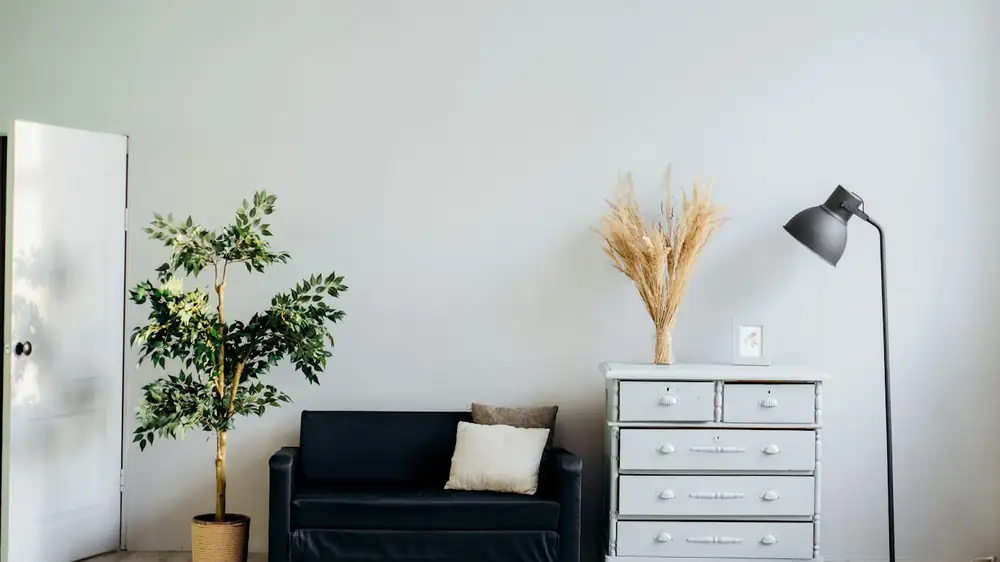
Light is the cheapest way to change how large a room feels, and the most commonly neglected.
A flat with one ceiling light per room looks smaller than the same flat with three light sources. This is not a stylistic preference — it is how human vision works. Multiple light sources create gradients and shadows, and shadows are how your eye reads depth. A single overhead light flattens everything.
This guide covers the layering principle, the colour temperatures that suit each room, and where lamps should actually go.
Why one light makes a room smaller
An overhead light does two things that work against perceived space:
1. It removes shadow. With light coming from directly above, walls and corners receive nearly the same illumination as the centre. Without variation, the eye reads the room as a flat plane rather than a volume.
2. It lights the ceiling. A ceiling that is brighter than the walls visually pushes the ceiling down, making the room feel lower. In a flat with 2.4 m ceilings, this is the difference between feeling cramped and feeling fine.
The alternative: light the walls, not the ceiling. A lamp at 1.2–1.5 m height throws light onto the wall, and a lit wall reads as further away.
The three layers
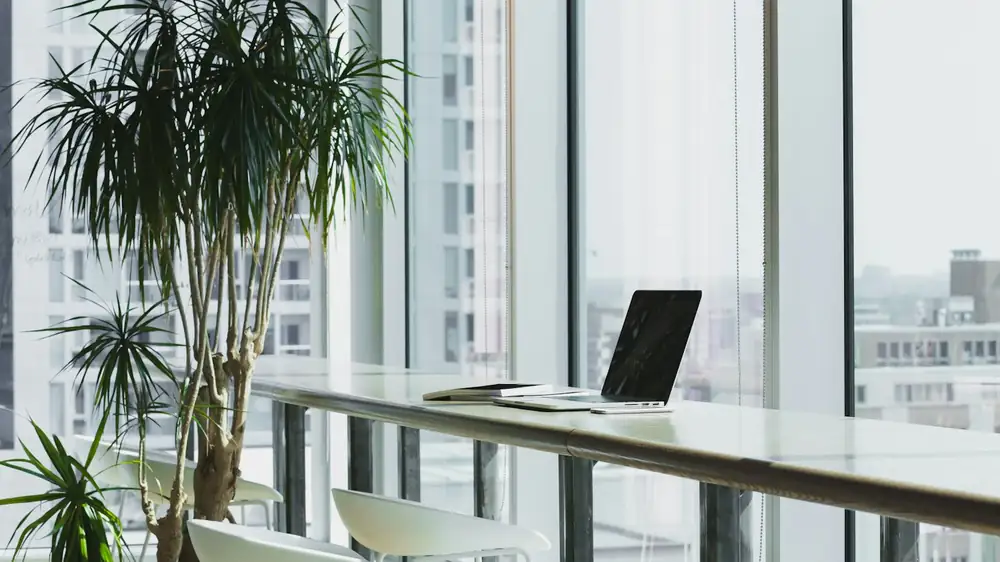
Every room benefits from three light layers, each doing a different job.
| Layer | Purpose | Height | Typical source |
|---|---|---|---|
| Ambient | Overall illumination | Ceiling or high wall | Ceiling fixture, or wall uplighters |
| Task | Seeing what you are doing | 40–50 cm above surface | Desk lamp, reading lamp |
| Accent | Depth and atmosphere | 30–150 cm, directed at walls | Floor lamp, table lamp, picture light |
The minimum viable version for a small flat: one ambient, one task, one accent per room. Three sources, three switches.
The most common mistake: treating the ceiling light as the ambient and stopping there. The ceiling light is the ambient, but without a task and an accent layer the room stays flat.
Colour temperature: the numbers that matter
Colour temperature is measured in Kelvin (K). Getting it wrong makes a room feel clinical or dingy, regardless of how much light there is.
| Kelvin | Appearance | Use |
|---|---|---|
| 2200–2700 K | Warm, amber | Bedside, living room evening |
| 2700–3000 K | Warm white | Living spaces, bedrooms (default) |
| 3000–3500 K | Neutral | Kitchen work areas, bathroom mirror |
| 4000 K | Cool white | Task lighting, home office |
| 5000–6500 K | Daylight | Not for living spaces |
The rule for small flats: 2700–3000 K everywhere except the kitchen work surface and the bathroom mirror, where 3500–4000 K helps you see what you are doing.
The mistake that ruins rooms: mixing temperatures in one sightline. A 2700 K table lamp beside a 6000 K ceiling light produces a colour clash that reads as "unfinished", even if nobody can name the problem. Keep every source in a room within 500 K of the others.
Where the lamps go
Position determines whether a lamp adds depth or just adds glare.
Floor lamp: behind and to one side of a seating position, throwing light up the wall. This lights the wall, which visually pushes it back.
Table lamp: on a side table at 50–60 cm, with a shade that directs light down and up rather than out. A bare bulb at eye level causes glare, which makes the room feel uncomfortable rather than larger.
Desk lamp: to the side of the working hand (left if right-handed), 40–50 cm above the desk, angled so the light falls on the work and not on your face.
Picture or wall light: 20–30 cm above the frame, angled down at 30 degrees. Lights the wall and the object, adds a bright patch that reads as depth.
The one position to avoid: a lamp directly in front of a seating position at eye level. It produces glare and reduces the perceived size of the room.
The mirror question
Mirrors do not create light, but they double the apparent depth of whatever they reflect.
Where a mirror works: opposite a window, or on a wall perpendicular to a window. It reflects the daylight and the depth of the room.
Where it fails: facing a blank wall, facing a cluttered corner (it doubles the clutter), or in a dark room with no light source to reflect.
The size rule: a mirror should be at least 60% of the width of the wall it is on to read as architectural rather than decorative. A small mirror on a large wall adds nothing.
Practical specifications
If you are buying bulbs and lamps for a small flat, these are the numbers that work.
| Room | Ambient | Task | Accent |
|---|---|---|---|
| Living | 1 ceiling or 2 uplighters, 2700 K | Reading lamp 400–600 lm | Floor lamp 300–500 lm |
| Bedroom | 1 ceiling, 2700 K | Bedside 200–300 lm each side | Optional |
| Kitchen | Ceiling or under-cabinet, 3000–3500 K | Under-cabinet 300 lm per 60 cm | None needed |
| Bathroom | Ceiling, 3500 K, IP44 rated | Mirror light 400 lm | None needed |
| Hallway | 1 ceiling or wall light, 2700 K | — | Optional |
Lumens, not watts. A 2700 K LED at 800 lumens is roughly equivalent to an old 60 W bulb. Buy by lumens and Kelvin; watts tell you almost nothing about LEDs.
Dimmable matters more than bright. A single dimmable 800 lm source covers both "evening" and "reading" better than two separate fixtures.
The rental constraint
In a rental you cannot rewire, and often cannot change fixtures. Three workarounds:
1. Plug-in wall lights. Battery or plug-in wall sconces that require no wiring, mounted with adhesive or a single small screw. Cost $20–50 each.
2. Plug-in pendant. A pendant on a long cord plugged into a wall socket, hung from a ceiling hook. Costs $30–60 and changes the room's character completely.
3. Lamp timers and smart plugs. Not a lighting change, but scheduling lamps so the room is lit before you arrive makes the flat feel intentional rather than dark.
What to avoid in a rental: anything requiring a new ceiling fixture, and anything that involves drilling into a wall you cannot repair.
The cheapest improvement that works
If the budget is nothing at all, do this: move one lamp from where it is to where a wall is.
A lamp in a corner, placed so its light falls across the wall rather than into the room, changes the perceived size of the space for free. The wall becomes a lit surface with a gradient, which the eye reads as depth.
That single move costs nothing and is the most effective lighting change in most small flats.
The honest summary
Light does more for perceived space than paint, furniture, or decluttering — and it costs less.
The principles are simple: three layers, one colour temperature family, light the walls not the ceiling, and avoid glare at eye level.
What it will not do: make a genuinely dark room bright at night, or fix a room where the layout blocks the window. Those are structural problems, and no lamp solves them.