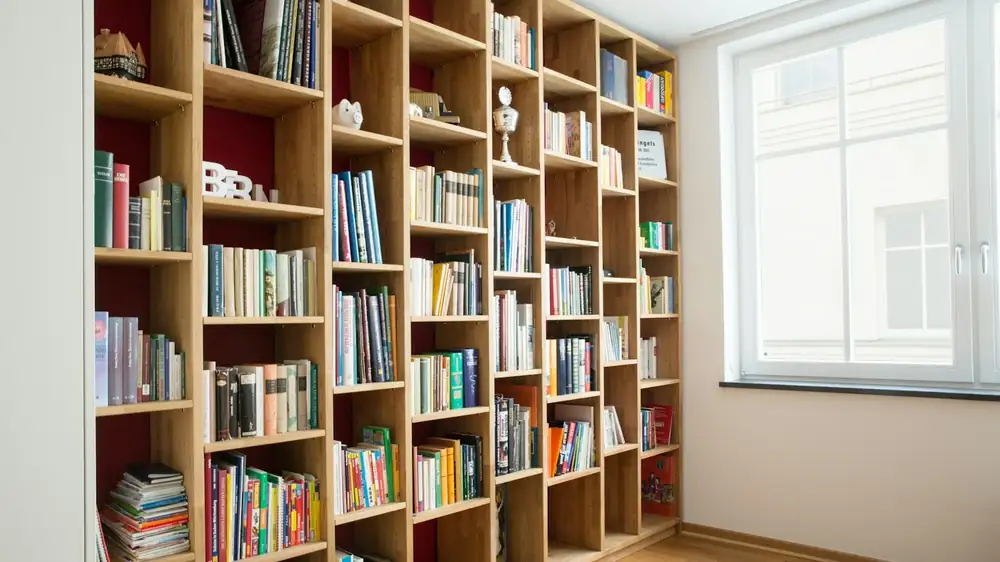
Storage containers are the most sold and least useful category in home organising.
They are useful in one specific situation: when you have volume but no structure, and a container lets you use space that was previously inaccessible. They are useless when the problem is that you have too much stuff, too little space, or a badly arranged cupboard — because in all three cases the container does not change any of those things.
This guide separates the containers that create capacity from the ones that only rearrange it.
The test: does it create capacity?
Before buying any container, ask one question: does this let me use space I cannot currently use?
| Container | Creates capacity? | Why |
|---|---|---|
| Pull-out drawer for a deep cabinet | Yes | Makes the back 40% reachable |
| Under-bed box on castors | Yes | Uses floor area that was empty |
| Two-tier riser for a shelf | Yes | Converts one layer into two |
| Over-door pocket organiser | Yes | Uses door surface, not floor |
| Drawer dividers | No | Rearranges what is already there |
| Matching glass jars | No | Same volume, prettier |
| Stackable baskets in an open shelf | Slight | Uses height, if the shelf has any |
| Vacuum bags | Marginal | Compresses once, then fails |
The top four create capacity. The bottom four do not. Most container spending goes to the bottom four, which is why people feel like organising is expensive and ineffective.
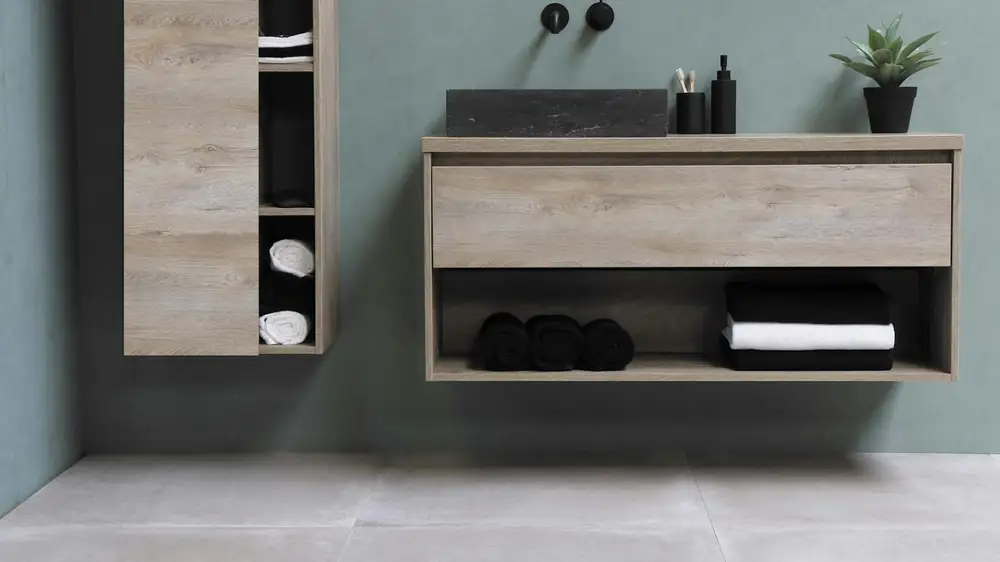
The six worth buying
1. Pull-out drawer for a deep base cabinet
Solves: the 15 cm dead zone at the back of every 60 cm kitchen cabinet.
Size: measure the cabinet's internal width and depth, then subtract 2 cm from each. The runners need clearance.
Cost: $30–60 per cabinet.
Why it works: it converts 60% access into 100%. No other purchase changes how a cabinet works at this price.
What to check: the runners must be full-extension. A partial-extension runner only brings the drawer out 70%, which does not solve the problem.
2. Under-bed box with castors
Solves: the floor area under a bed frame.
Size: measure the clearance in the middle of the bed, then buy boxes 2 cm shorter. Standard 60 × 80 × 18 cm fits most frames.
Cost: $15–25 each. Four is usually the right number.
Why it works: castors are the difference between a box you use and a box you never touch. A loaded box without wheels cannot be pulled across carpet.
What to check: castors on all four corners, and a moulded pull handle on the long side facing outward.
3. Two-tier riser
Solves: the single layer on a shelf that has 20–30 cm of unused headroom.
Size: the riser's depth must be within 2 cm of the shelf depth, and its height must clear the shelf above.
Cost: $10–15.
Why it works: it is the cheapest capacity you will ever buy. Doubling the usable layers of a shelf for $12 is unmatched value.
Where it works best: kitchen cabinets (glasses, mugs, tins), bathroom shelves (bottles), and pantry shelves (jars).
Where it fails: shelves under 25 cm of headroom, because you cannot reach the top tier.
4. Over-door pocket organiser
Solves: the back of any door.
Size: check door thickness (most fit 35–45 mm) and the gap above the door (need 4 mm).
Cost: $15–30.
Why it works: a door is 1.9 m × 0.8 m of flat surface that costs nothing. Pockets use it without any fixing.
Best for: shoes (a shoe-pocket version holds 10–12 pairs), bathroom items, cleaning supplies in a cupboard door, stationery.
Where it fails: heavy items. Pockets are rated low (3–5 kg total) and sag under load.
5. Clear stackable bins for the top shelf
Solves: the top shelf you cannot see into.
Size: choose bins that fit within the shelf depth and stack two high.
Cost: $8–15 each.
Why it works: the top shelf is only useful if you can identify contents without climbing. Clear bins with a label on the short end solve that.
What to avoid: opaque bins on a high shelf. If you cannot see or read the label from below, you will not use the contents.
6. Tension rod (a container in the functional sense)
Solves: the vertical space inside a cabinet, closet, or under a sink.
Size: measure the span, then buy a rod 5–10 cm longer than the span (they extend).
Cost: $10–20.
Why it works: a rod plus S-hooks or hanging baskets creates hanging storage where there was none, with zero fixings.
Load: 10–15 kg for a 22 mm rod under 1.2 m span. Halve it for glossy surfaces.
The containers to skip
Matching glass jars. They cost $3–8 each, they do not create capacity, and they destroy the packaging information you need. Their only real benefit is aesthetics, and they are the single largest line item in most "organising hauls".
Drawer dividers sized exactly to the drawer. They shift, look broken, and trigger reorganisation. Buy 10% smaller, or skip.
Vacuum bags. They compress once, fail at the seam, hide the contents, and cannot stack. Use a box.
Fabric storage boxes with a lid and no structure. They collapse when loaded, cannot stack, and the lid warps within a year.
Nesting baskets in three sizes. The smallest is always useless, and the set is priced as if all three were needed.
Anything sold as a "complete set". A set of twelve containers is designed to look complete. The right number for your space is rarely twelve.
How to size a container correctly
Three measurements, in this order.
1. The internal width between obstructions. Not the outer width of the shelf — the space between the shelf supports, or between the cabinet walls at the level the container will sit.
2. The depth, minus 2 cm. Containers need clearance to be inserted and removed. A container that fits exactly cannot be taken out.
3. The height available above. The shelf above is usually 2–3 cm closer than the shelf spacing suggests, because of its own thickness.
Then subtract 10% from the resulting volume and buy that size. The slack is what makes the container usable rather than a puzzle.
The buying order
If you have a budget, spend it in this order:
| Priority | Item | Cost | Effect |
|---|---|---|---|
| 1 | Under-bed boxes with castors | $60–100 | Largest single volume gain |
| 2 | Pull-out drawer for the worst cabinet | $30–60 | Fixes the biggest access problem |
| 3 | Tension rod + hooks | $12–20 | Free vertical space |
| 4 | Two-tier risers (2–3) | $20–45 | Doubles shelf layers |
| 5 | Over-door organiser | $15–30 | Uses door surfaces |
| 6 | Clear bins for the top shelf | $16–30 | Makes high storage usable |
Total: about $150–285 for a complete, functional set that covers most small-flat problems. Notice that most of it is not "containers" in the decorative sense.
The rule that saves the most money
Do not buy containers until you have emptied, sorted, and measured.
The sequence most people follow:
- Decide to get organised
- Buy a set of containers
- Try to fit existing items into the containers
- Discover the containers do not match what they own
- Buy more containers
- Abandon the project
The sequence that works:
- Empty the space completely
- Sort by frequency of use
- Remove what does not belong
- Measure the space and the items
- Buy only what the measurements indicate
- Put back, leaving 20% empty
Step 5 is often "nothing". In a majority of the spaces I have audited, the honest answer after steps 1–4 was that no purchase was needed, because the problem had been arrangement and overflow rather than container shortage.
What containers cannot do
They cannot create space. They cannot fix a room that is over-full. They cannot make up for the absence of a system.
A container is a tool for using volume you already have. If the volume is not there, the container will sit on the floor being in the way — which is how most abandoned organising projects end.
The test at the top of this article is the whole guide: does this let me use space I cannot currently use? If yes, buy it. If no, the money is better spent elsewhere.