
A load of washing contains about 2–3 litres of water that has to go somewhere. If it evaporates inside a flat with the windows closed, it condenses on the coldest surface — usually an external wall or a window reveal — and that is how mould begins.
This is not a small problem. It is the single most common cause of damp in small flats, and the reason landlords' inventories mention ventilation.
This guide covers drying methods ranked by speed and cost, the ventilation requirement, and where the setup should go.
The moisture maths
| Item | Water content |
|---|---|
| One load of washing (5 kg dry) | 2–3 litres |
| One bath towel | 0.5–0.8 litres |
| Keeping a window closed during drying | 100% of that stays indoors |
To keep indoor humidity below 60% during drying, you need to remove that moisture. Two ways:
Ventilation: open a window. A single window open 10 cm for the duration of drying exchanges enough air in most small flats.
Dehumidification: a desiccant or compressor dehumidifier pulls 2–4 litres a day from the air, which covers one load.
Doing neither is what causes the problem. A window open during drying is free and effective; it just needs to actually be done, every time.
Drying methods, ranked
1. Heated airer — best overall
What it is: a freestanding rack with heated bars, typically 300–400 W.
Speed: 3–5 hours for a full load.
Cost: $60–120 to buy, roughly $0.10–0.15 per load in electricity.
Why it wins: fast enough to be practical, and it dries without the condensation that unheated indoor drying causes, because the moisture is driven off more quickly and with the bars heated, the local humidity around the clothes stays lower.
The constraint: it occupies about 1 m² of floor for 4 hours. That is the trade-off in a small flat.
Where it goes: the bathroom, if there is 1 m² of floor. Otherwise a corner of the living room, near a window.
2. Washing machine with a built-in dryer — best if you have one
Speed: 2–3 hours for a full load.
Cost: part of the machine.
Why it is not first: most washer-dryers are condensing type and need ventilation, and their drying capacity is usually half their washing capacity — a 7 kg washer dries 3.5 kg. Two loads of washing become three drying cycles.
The advantage: no floor space needed during drying, which in a very small flat is decisive.
3. Dehumidifier + standard airer — cheapest running cost
Speed: 4–6 hours.
Cost: dehumidifier $100–200, airer $20–30, electricity $0.15–0.25 per load.
Why it works: the dehumidifier removes the moisture, so the room stays dry and the clothes dry faster than they would in still air.
The advantage: the dehumidifier is useful for other things (damp corners, bathroom after showers), so it is not a single-purpose purchase.
4. Standard airer + open window — cheapest
Speed: 8–24 hours depending on conditions.
Cost: airer $15–30, nothing to run.
Why it is last: it works, but slowly, and it depends entirely on the window being open the whole time. In winter, that means a cold room.
The realistic use: overnight drying with a window cracked and the door closed. Works in spring and autumn; struggles in winter and humid weather.
5. Tumble dryer — rarely viable
Space: 60 × 60 cm of floor, permanently.
Cost: $300+, plus electricity at roughly $0.40–0.60 per load.
Venting: a condensing dryer needs no external vent but produces heat and humidity in the room; a vented dryer needs a hole in the wall.
In a small flat: the space and the running cost rarely justify it unless drying is a genuine daily problem.

Where the setup goes
The best location for drying in a small flat is the bathroom, for three reasons:
- It is already ventilated (extractor fan)
- It has a hard floor that tolerates drips
- A door can close it off
The arrangement that works in a 2 m² bathroom:
| Position | Item |
|---|---|
| Above the bath or shower | Retractable line across, 2–3 m |
| Floor corner | Heated airer or standard airer |
| Wall | Fold-down drying rack |
| Door | Over-door hooks for a few items |
If the bathroom is too small: the bedroom is the second choice, but only with a window open and the door closed. The living room is last, because the moisture and the visual clutter both affect the space you use most.
The washing machine placement problem
In most small flats the machine is in the kitchen, under the counter. That works, with two caveats:
Washing machines in kitchens need ventilation during drying. If the machine dries, it releases moisture into the kitchen.
The drain must not be shared with the kitchen sink without a trap, or smells come back. This is a plumbing detail worth checking, and it is a common cause of a persistent smell.
The alternative in a flat with no space: a compact 3 kg machine that fits under a counter (60 × 50 cm) or a twin-tub. Not as convenient, but it fits.
The anti-mould routine
If you dry indoors, three habits prevent the mould that otherwise appears within a season:
1. Open a window, every time. Not "sometimes" — every time. Ten centimetres is enough.
2. Wipe the window reveal and the external wall after drying. That is where condensation lands first. A dry cloth once a week prevents the black spots.
3. Run the extractor fan in the bathroom for 20 minutes after drying. It removes the moisture that collects at ceiling level.
The tell-tale sign of a problem: a musty smell in the room where you dry clothes. That smell is mould starting in a place you cannot see, usually behind furniture or in the carpet underlay.
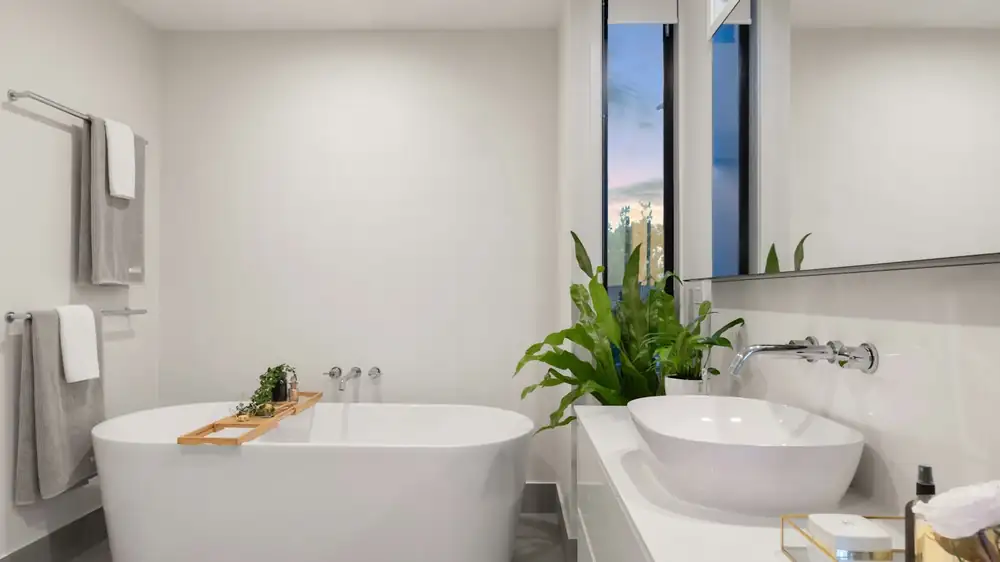
Storage for laundry items
The other half of the laundry problem is where the baskets, detergents and ironing board live.
| Item | Usual place | Better place |
|---|---|---|
| Laundry basket | Bedroom floor | Hanging bag on the bathroom door |
| Detergent | On the machine | Inside a cupboard, decanted into a smaller bottle |
| Ironing board | Behind a door | Fold-down wall board, or under the bed |
| Iron | On a shelf | In a drawer (it takes 15 × 30 cm) |
| Drying rack | Leaning on a wall | Folded flat behind the machine or under a bed |
| Spare bedding | Under the bed | Vacuum bag in a drawer |
The single most useful change: hang the laundry bag on the bathroom door instead of leaving a basket on the bedroom floor. It removes a floor item, it is closer to the machine, and it holds more than a basket in less space.
The honest summary
Drying laundry indoors is fine if you ventilate. It causes mould if you do not. The ventilation is free and the mould costs hundreds to fix, so the economics are not close.
A heated airer is the best compromise in a small flat: fast enough to be practical, and it does not require a window open in winter.
What no method solves: a flat with no window in the bathroom and no space for an airer. In that case, a laundrette for drying is a rational choice rather than a defeat.