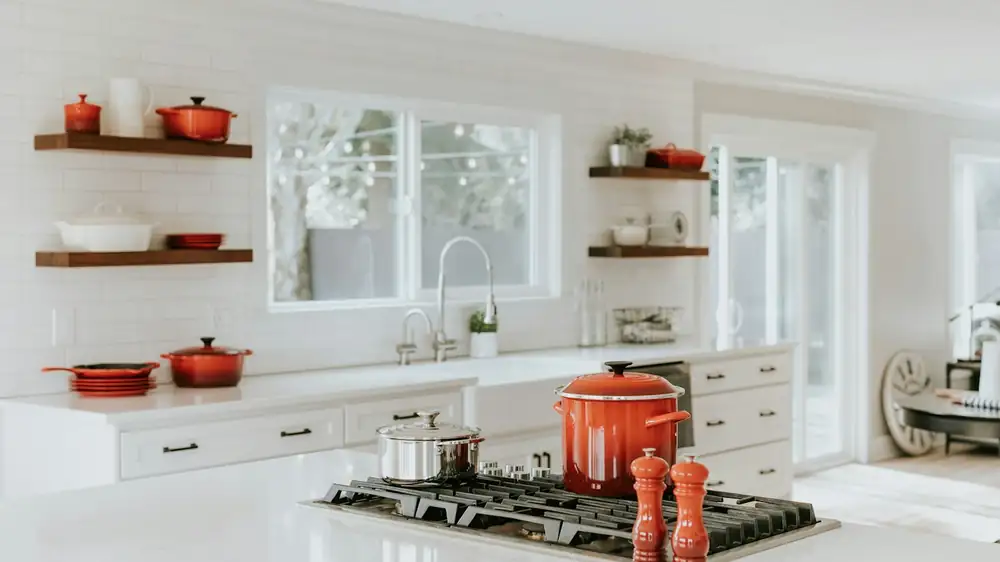
A small kitchen counter is 1.2–2 metres long. Every appliance that lives on it permanently removes 25–40 cm, and six appliances consume the entire counter.
The question is not which appliances are useful — most are. It is which ones earn a permanent position, and which should live in a cupboard, or not be owned at all.
The space-per-use calculation
The useful metric: cubic metres of storage occupied per use per year.
| Appliance | Footprint | Stored where | Uses/year | Space-year cost |
|---|---|---|---|---|
| Kettle | 20×20 cm | Counter | 700+ | Negligible |
| Toaster | 30×20 cm | Counter | 300+ | Negligible |
| Coffee machine | 25×35 cm | Counter | 400+ | Negligible |
| Stand mixer | 35×25 cm | Counter or cupboard | 20–40 | High |
| Air fryer | 35×35 cm | Counter | 100–200 | Medium |
| Slow cooker | 30×30 cm | Cupboard | 30–60 | High |
| Blender | 20×20 cm | Cupboard | 40–80 | Medium |
| Bread maker | 35×30 cm | Cupboard | 10–30 | Very high |
| Juicer | 25×30 cm | Cupboard | 5–15 | Very high |
| Rice cooker | 25×25 cm | Counter or cupboard | 60–150 | Low |
The pattern: appliances used daily justify permanent counter space. Appliances used monthly or less should be in a cupboard, and if they are too big to store conveniently, they should not be owned.
A specific case that surprises people: a stand mixer is the most-kept and least-used appliance in small kitchens. It weighs 8–10 kg, occupies a 35 × 25 cm footprint permanently, and in a household that bakes twice a month it is used 24 times a year. That is 0.09 m³ of prime counter occupied 365 days for 24 uses.
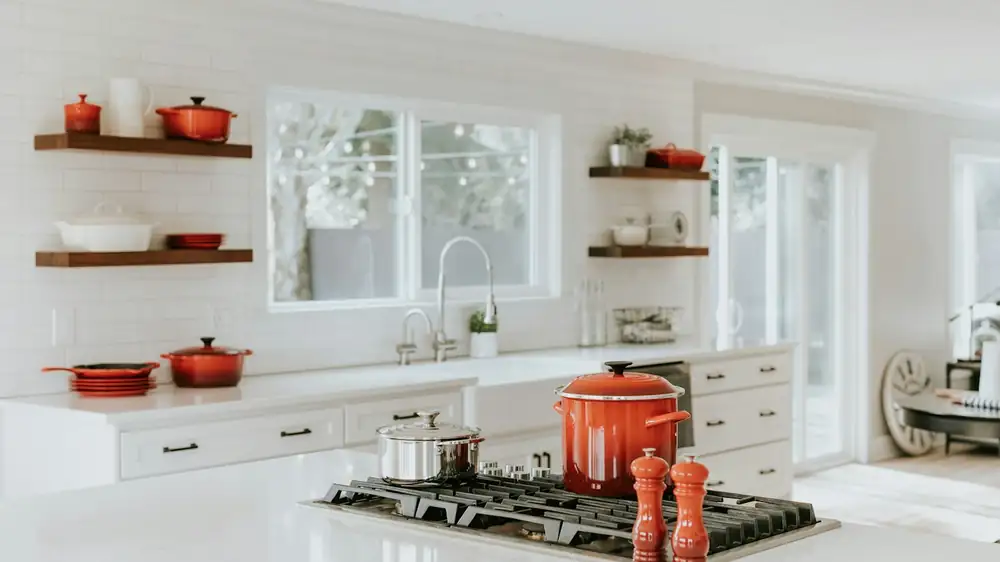
The six that earn counter space
| Appliance | Justification |
|---|---|
| Kettle | Used multiple times daily, no alternative |
| Toaster | Daily, and awkward to store (crumbs) |
| Coffee machine (if used daily) | Daily, and it needs to stay plumbed/warm |
| Rice cooker (if used 3+ times weekly) | Frequent and hot to move |
| Air fryer (if used 4+ times weekly) | Frequent and bulky |
| Dish rack or drainer | Not an appliance, but it requires counter |
That is six items and roughly 1.5 m of counter. In a kitchen with 1.2 m of counter, that is already over budget, which means something has to be demoted.
The demotion ladder
When counter space runs out, appliances come off in this order:
Level 1 — cupboard with easy access (daily to weekly): air fryer, rice cooker, blender. On a shelf at chest height, no lifting from below.
Level 2 — high or low cupboard (monthly): slow cooker, food processor, sandwich press. Needs a step or a squat, acceptable at monthly frequency.
Level 3 — out of the kitchen (rarely): bread maker, juicer, ice cream maker, dehydrator. Store in a hallway cupboard, under the bed, or in a storage box — anywhere except the kitchen.
Level 4 — not owned: anything used less than ten times a year and costing more than $50. Borrow, hire, or buy ready-made.
The honest test for Level 4: if you would have to think about when you last used it, it belongs here.
The appliances that are genuinely worth it in a small kitchen
1. A multi-function pressure cooker. Replaces a slow cooker, a rice cooker, and a steamer — three appliances in one footprint. Cost: $70–150. This is the single best appliance purchase for a small kitchen, because it consolidates rather than adds.
2. A compact air fryer. 25 × 30 cm rather than 35 × 35 cm. Holds enough for one or two people, and it replaces the oven for most small meals, which matters when the oven is a major cleaning job.
3. A stick blender. Stores in a drawer (unlike a jug blender, which occupies 20 × 20 cm of counter or cupboard). Handles soup, sauces, and smoothies. Cost: $25–50. This is the small-kitchen answer to "I want a blender".
4. A two-slice toaster, not a four-slice. A four-slice toaster is 40 cm wide and does the same job twice as slowly as doing two rounds in a two-slice. Cost: half as much.
5. A kettle sized to your use. A 1.7 litre kettle takes 40 seconds longer to boil than a 1 litre one, and it occupies 20 cm regardless. For one or two people, 1 litre is correct.
The appliances to skip in a small kitchen
| Appliance | Why to skip |
|---|---|
| Stand mixer | 0.09 m³ of counter for monthly use; a hand mixer costs $25 and stores in a drawer |
| Bread maker | Only worth it if baking weekly; otherwise buy bread |
| Juicer | Cleaning time exceeds the benefit; used rarely |
| Ice cream maker | Freezer space is scarcer than counter space |
| Electric griddle | A pan does the same |
| Waffle maker | Single-purpose, bulky, used rarely |
| Sous-vide circulator | Requires a container that also takes space |
| Soda maker | Takes counter and needs gas refills |
The common thread: single-purpose appliances with high volume and low frequency. Multi-purpose appliances that replace two or three others are the opposite, and those are the ones worth buying.
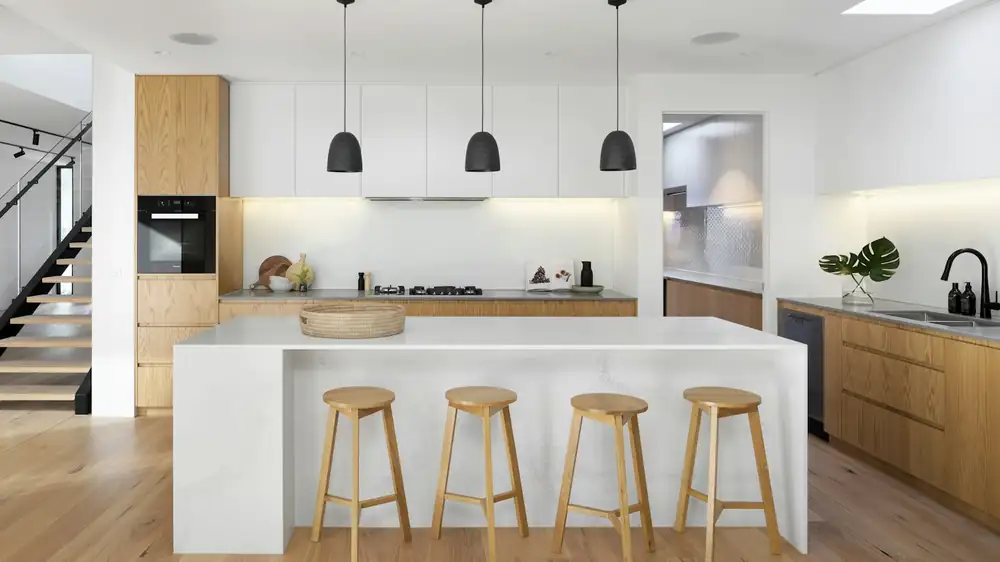
The cupboard storage that makes demotion work
If appliances live in cupboards, the cupboards must be arranged for it — otherwise they stay on the counter because they are too annoying to retrieve.
The arrangement that works:
| Level | Cupboard position | Appliances |
|---|---|---|
| No lifting | Chest height shelf | Air fryer, blender, food processor |
| Slight bend | Waist height | Slow cooker, sandwich press |
| Squat | Bottom shelf, on a pull-out | Heavy items (stand mixer, if kept) |
| Step required | Top shelf | Rarely used items |
The pull-out shelf detail: in a base cabinet, a pull-out shelf ($25–50) makes the bottom level accessible, which is exactly where heavy appliances sit. Without it, the heaviest items are in the least accessible place — which is why they end up back on the counter.
The counter-to-cupboard rule: an appliance will only stay in a cupboard if retrieving it takes under 15 seconds. If it involves moving something else, it will not happen.
The honest arithmetic for a small kitchen
| Counter length | Appliances that can live on it | The rest |
|---|---|---|
| 1.2 m | Kettle, toaster | Everything else stored |
| 1.5 m | Kettle, toaster, one more | Everything else stored |
| 2.0 m | Kettle, toaster, coffee machine, one more | Everything else stored |
| 2.5 m+ | All daily appliances | Occasional stored |
Most small flats have 1.2–1.5 m of counter. That means two or three permanent appliances, and the rest either in a cupboard or not owned.
Trying to keep six appliances on a 1.2 m counter is why so many small kitchens have no work surface at all — and a kitchen with no work surface makes cooking unpleasant, which then makes the appliances unused, which means they occupy the counter for nothing.
The one thing that matters most
A clear stretch of counter is worth more than the appliances that compete for it.
Cooking needs 60 cm of clear surface. In a kitchen with 1.2 m of counter and four appliances, there is no clear 60 cm, so every meal involves moving things. That is the actual cost of a cluttered counter: not aesthetics, but that cooking becomes a chore.
Demote the appliances until 60 cm is permanently clear, and the kitchen starts being used. That is the whole principle.